Pages

Tuesday, August 21, 2012

VITTHALA AND THE VIJAYANAGARA EMPIRE:FOLK DEITIES AND SOCIETY

The Rise of a Folk God: Vitthal of Pandarpur
Ramachandra Chintaman Dhere
New Delhi: Permanent Black 2012

The spread of the Vijayanagara Empire throughout Peninsular India brought in its wake social changes which are now being investigated by historians. The gradual transformation of forest dwellers and tribal social groups into social formations allied to or integrated within the Hindu conceptual universe remains the most prominent feature of the social landscape of the last precolonial polity/empire of South India. There are transcriptional evidence to demonstrate that in parts of South India when social groups were enumerated in inscriptions an implied hierarchy  was already in place and when we look back at the history of the communities we find that they were rather late entrants into peasant society. One area of research which has opened by in recent years is the study of society and social change as is reflected in songs, ballads, hymns and devotional compositions. The book under review analyses the  cult of Vitthal in its setting in the Warkari tradition of Maharashtra. A recent Ph D thesis entitled The Songs of Purandaradasa in the Social,Historical and Religious Context of the Vijayanagara Empire submitted to Pondicherry University by Divya Sandesh looks at the patronage extended to the cult of Vitthala by the Rayas of Vijayanagara as a strategy to integrate marginal social groups like the Dhangars within the framework of the Vijayanagara state.

The work attempts a reconstruction of the religious tradition and practices surrounding the emergence of Vitthala as Vaishanava deity during the early medieval period. Part of the work was undertaken earlier by the Jesuit priest and scholar Father G A Delury whose Cult of Vithoba still remains one of the most important studies on this theme. Dhere wrote this book in Marathi and it  has been ably translated by Dr Anne Feldhaus. He is at pains to uncover the "identity"of Vitthala about whom even Purandaradasa is said to have remarked in one of his songs: Show me who you really are or I will tell the world the truth about you. It is clear that the identity of Vitthala or Vitthoba was a contested one even during the medieval period. Though he is considered to be form of Vishnu, the fact is that Vitthala like Venkatesvara is not one of the avatars of Vishnu or is he even included in the list of 24 upaavataras. Dhere traces the Vaishnavisation of Vitthala to the Wakari movement, the quintessential pilgrimage and circulation of bhaktas in Maharashtra. This movement seems to have begun in the eleventh century when the Yadavas of Devagiri were the dominant political force in the Deccan region and got absorbed into the larger pan-Indian Bhakthi tradition as a consequence of the  interaction between the Deccan and the Tamil  tradition as ably shown by Dr Divya Sandesh in the thesis already cited.

The author has used a particular kind of religious text known as the Panduranga Mahatmya in order to explore the spiritual and religious aspects of the Vitthala cult. This genre of texts is particularly difficult for historians to accept as source material because of the difficulty we have in arriving at a date for their composition.


 The same difficulty is faced by those historians who use ephemeral sources like abhangs and kirtans of saint composers like Purandaradasa whose compositions were collected and collated only towards the end of the nineteenth century. During the four centuries when songs and hagiography circulated in an oral medium there would have been considerable contamination by the incorporation of later elements and of course certain fundamental changes in the text itself due to the sectarian or political interests of the redactor. However, most historians assume that the texts they are dealing with retain their pristime quality, an assumption which is challenged by the work of Lord and Father Walter Ong. During the Vijayanagara period we find the spread of the cult of Vitthala to parts of Peninsular India where Vitthala was virtually unknown. One argument which has been put forwards by the historian cited earlier Dr Divya Sandesh, is to link the spread of the cult to the political needs and compulsions of the Vijayanagara state itself. She has shown that saint singers like Purandaradasa who traveled extensively in the Empire from Pandarpur in the North to Srirangam in the South created a sacred landscape in which the Vijayangara Empire became more or less coeval with the sacrality of deities like Vitthala and Narasimha whose worship was very popular during the period.

A question which Chintamani Dhere does not ask but is worth asking is: Did Vijayanagara promote the worship of Vitthala at the fabulous temple constructed at Hampi in order to appropriate the sanctity of Pandarpur after it had been conquered by the Adil Shahis Sultanate. This is a historical issue and we cannot fault Dhere for not attempting an answer. All in all this is a serious book and addresses the issue of popular religious cult and practices centering around the worship of theis pastoral deity in a detailed manner.


Thursday, February 16, 2012

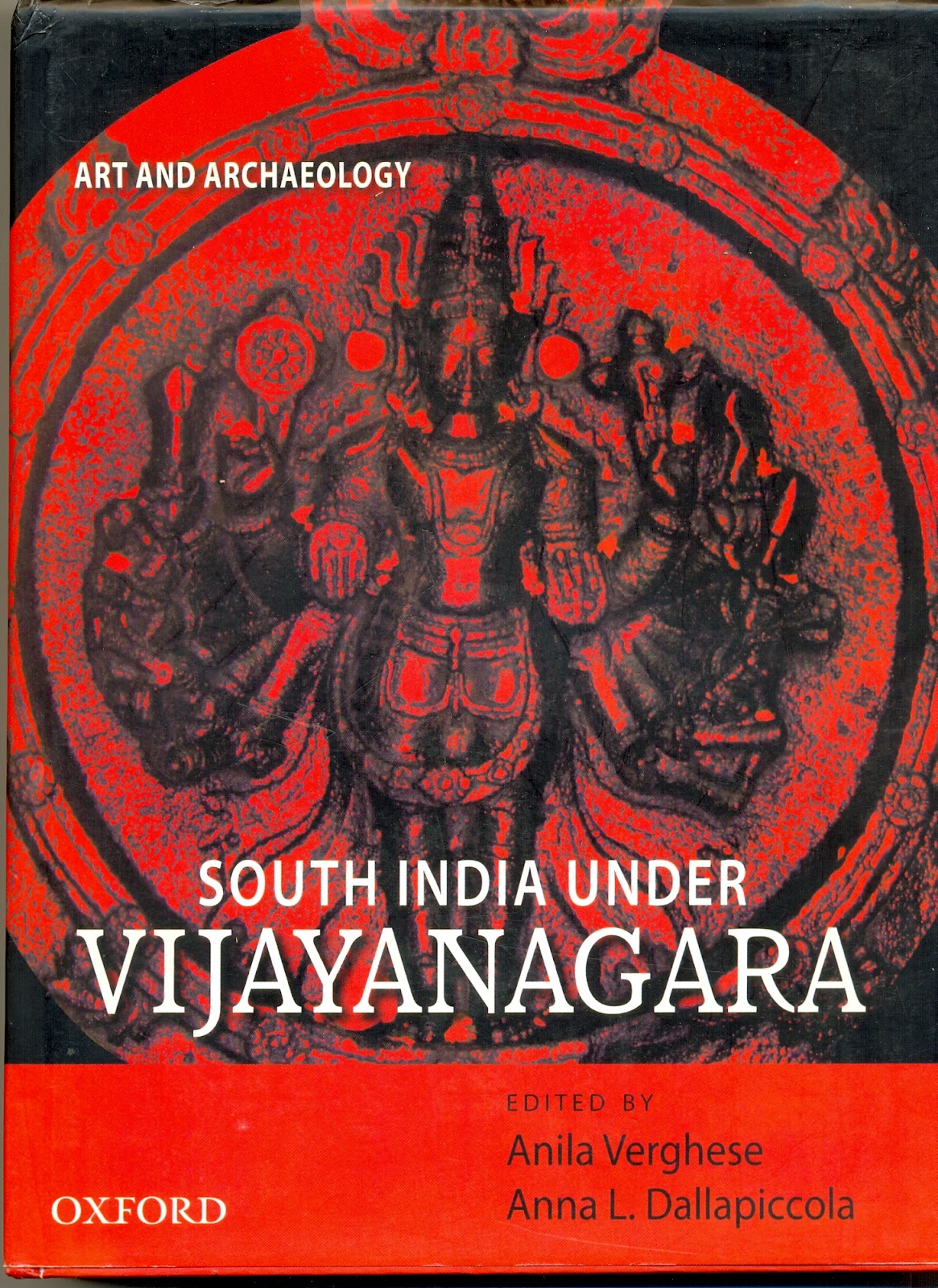
SOUTH INDIA UNDER VIJAYANAGARA ED. ANILA VERGHESE AND ANNA DALLAPICCOLA

South India under Vijayanagara: Art and Archaeology
Ed Anila Verghese and Anna Dallapiccola
New Delhi: Oxford University Press, 2011

In 1900, when Robert Sewell the ICS officer and historian published the Forgotten Empire Vijayangara had faded into oblivion with Lethe hanging heavy on the memoria of the last imperial power of Peninsular India. Since then Vijayanagara has emerged as a promising field of inquiry partly due to the onset of "identity politics" of the early twentieth century with its twin avatars in the form of caste and lanuage. Were the early founders of Vijayanagara from the Kannada region or the Telugu region. This question animated a great deal of the early historiography of Vijayanagara with scholars like Srikantaiya advocation the Hoysala origin of the Sangamas and Venkataramanyya advocating the Kakatiya origin. Shedon Pollock has quite rightly stated in his Language of the Gods in the World of Men that vernacularization of the Peninsualr polities began as early as the days of the Rashtrakutas and continued apace during the Vijayanagara period. In fact the titles bornes of the ealy Sangama rulers recognise the desh bhasha  when they proudly accord the primary status to regions like Karnat and Telnengu in their inscriptions. Historians have virtually fragmented the Vijayanagara Empire into linguistic zones, a trend that has distorted the study and research on Vijaynagara. Fortunately the volume which is being reviewed herein eschews this trend and looks at Vijayanagara in a more comprehensive manner.

Anila Verghese and Anna Dallapiccola are both well established scholars on Vijaynagara who have worked on the Vijyanagara Reseach Project constituted by Gerrge Michell and John Fritz. The past three decades have seen large sclae exploration and ecxavation in and around the Royal Center at Hampi which has led to a total reapprisal of historical knowledge regarding the urban form and morphology of Vijayaanagara. Unlike other capital cities of Peninsular India, Vijayanagara has had a large number of visitors who have left eyewitness accounts of their experience in Vijyanagara. The discovery and publication of the manuscripts of the Portuguese horse dealer Paes and Nuniz in the archives at Lisbon in the late nineteenth century opened up a vey interesting chapter in Vijayanagara research in that textual evidence could be tested against archeological material. One consequence of this method, though untended, was to view the many landscapes of Vijayangara through the "lens" of foreign visitors. Every building or piece of monumental architectre was identified using literary accounts. Thus the account of the nine day Mahanavami Festival formed the basis for identifying the Throne Platforms found in the royal core of Vijyanagara.

This book contains 24 articles each one of them exploring an interesting aspect of Vijaynagara material culture. Philip Wagoner's article on the "Stepped Well" found in the capital is a remarkable piece of historical scholarship. He demonstrates that the architectural marvel was brought from Kalyan, and it was moved to Vijayanagara during the 16th century when effort was made to link Vijaynagara with the past of the Chalukyas of Kalyan.AnilaVerghese in her contribution  looks at the "sacred topography" of Vijaynagara on the basis of inscriptions and the associated myhs of temples. The thene of the Ramayana looms large in the political imagination of Vijayangara and one sees a tendency to expoit mythic associations and popular memory in order to sacralise the landscape of Vijayanagara. This trend toward scaralizing the landscape was further reinforced by the dasakuta tradition represented by the haridasa singers of whom Purandaradasa was the most preeminent. A recent Ph D thesis submitted by a student of mine explores this theme is a substantial manner.

This volume is a excellent attempt at systhesising the  state of the art in so far as Vijaynagara studies is concerend and will be useful to students and researchers alike.

Tuesday, February 7, 2012

SOCIAL LIFE AS REFLECTED IN NAYAKA PAINTINGS; THE TIRUPPUDAIMARUDUR PAINTINGS

A Study of Nayaka-Period Social Life: Tiruppudaimarudur paintings
Institute Francais de Pondichery
Jean Deloche, 2012

Indian paintings have hardly attracted attention, except for the precocious Ajanta Cave murals. Even Sivaramamurthi chose to concentrate on paintings found on the walls of Tamil temples particularly the famous paintings found in the Brihadesvara Temple at Tanjavur. The reason why paintings have been a neglected area of study can easily be determined. India offers a very rich fare in Sculpture, Iconography, Architecture and the identification of sculptural representations with the agamic sources and texts formed the basis of art history ever since T A Gopinath Rao published his monumental Elements of Hindu Inconography. Indeed it may even be argued that the only enduring paradigm for studying south Indian art and architecture was legislated by Gopinath Rao nearly a century back. Obviously this method of inquiry previleged the works of art found in Saiva and Vaishanva temples with elaborate treatises being composed on arcane matters of textual reconstruction and identification. While Gopinath Rao made a good beginning, he certainly did not wish that his method of investigatiom would be the classic statement frozen in time and beyond critical scrutiny. The French Institute of Pondicherry has been at the forefront of new methods and perspectives in the study of south Indian art amnd architecture.

Jean Deloche is well known historian famous for his study on roads and networks of transport and communication in India prior to the advent of European colonialism. More recently he published an excellent monograph on the medieval fort of Senji located in South Arcot district. The books under review is his most recent publication. While his earlier work betrays the influence of the Annaliste group of historians, that shadow seems to be lifting in his later and more recent publications. Theoretical issues are barely referred to in this slim volume.

The murals which were discovered in the late Pandyan temple dedicated to a Saivite deity, covered the walls of the gopura which has 5 teirs. The murals are found all along the walls of the gopura. Deloche correctly dates them to the Vijayanagra period, though the term nayaka period seems to be ambiguous. Deloche seems to regard the presence of handguns in some of the murals to be evidence of a late date. It is well known that even Krishnadevaraya used firearms in the Battle of Raichur, AD 1520. Ma Huan's account found in the  Overall Survey of the Ocean Shores shows that firearms were used by Zheng-He during his foray into the Arabian Sea/Indian Ocean. Another piece of evidence that he uses for dating the paintings is the presence of curb bits which according to him were intoroduced only in the 17th century. The use of internal evidence for dating the murals is an interesting idea but may not be entirely reliable.

The paintings depict scence from the medieval text Tiruvilaiyatapuranam which has been found in innmerable manuscript versions all over the Tamil region. Deloche has identified the paintings using this text. Apart from the religious or sectarian themes, Deloche has made a fairly comprehensive study of the ships shown in the paintings. One of the vessels, a tall ship with a half deck clearly shows horses and the author argues that the ship could have been a Portuguese ship. From the term parasika which actually means Persian and a term which is found even in Chola inscriptions, Deloche wrongly deduces the reference to Portuguese. The murals clearly show Indian soldiers carrying firearms, though the main battle weapon seems to have been the pike and the sword. An interesting illustration shows Europeans carrying firearms (fig. 94).

This is a very interesting book and the methodology employed is critical and some of the conclusions drawn are nuanced. However given the highly naturalistic style and the absence of conventional elements, we may have to further investigate the origins of natualistic art in Peninsular India. The illustrations are excellent and on the whole this book is a worthwhile addition to the slender library of art of the sixteenth and seventeenth century.

Sunday, January 29, 2012

ROYAL IMAGERY AND NETWORKS OF POWER AT VIJAYANAGARA; A REVIEW

Royal Imagery and Networks of Power at Vijayanagara: A study of Kingship in South India
Dr Nalini Rao
NEW DELHI, 2010.

Vijayanagara kingship, the conceptual universe within which the rayas of Vijayanagara lived and expressed their ideas of politics and statecraft, remains an enigmatic subject. There is one basic reason for this: there are no contemporary histories or documents which reveal the strnads that constituted the complex fabric of political ideologies glossed under the rubric, kingship. Skinner has argued that it is possible to use what he calls the "intentional method" in order to unpack the linguistic conventions and ideologies which animate political action. The contextual approach favored by medieval western historians on the theme of statecraft does not find favor among historians of medieval South India, priamrily because bgoth the State and the ideologies underpinning it come prefigured in the package known as "Divine Kingship".For a variety of reasons, partly due to the heavy cloud of orientalism hanging on Indic studies, India kings and the normative vocabulary available for describing the actions of kings,are assimilated to notions of divinity,devaraja, rajadharma etc all of which assume an element of sacerdotal power as the constituent element of Indian kingship. Indian kings and their courtly prasasti composers have also conspired to create the image of divine king so beloved of Indian historiography. The genealogies of medieval kings is replete with references to almost every known puranic god who contibute in some measure in gining an air of royal mytique to the king.

Vijayanagara Empire, the last major political formation of Peninsular India before the advent of western military and economic hegemony, left behind a rich set of copper plate records and nearly 3,500 stone inscriptions along with a veritable treasure trove of sculptures, monumental architecture, and a magnificent royal capital--the City of Victory--all of which can be interogated for clues on the ever elusive conundrum of kingship. Nalini Rao has attempted just this in her recent book which is reviewed here.

The book under review essentially deals with the third dynasty and more particularly it centers on the reign of Krishnadevaraya (1509-1529). She surveys the urban context of Vijayangara on the basis of extant secondary sources. The well known visitors in the fifteenth and sixteenth centuries are referred and an attempt is made to identify the public buildings mentioned by early visitors with the archeological evidence which has become available over the past three decades thanks in part to the pioneering work done by thehistorians like M S Najaraja Rao and the achitectural team of George Michell and John Fritz. A question which the author does not raise, but is relevant to the theme of her book is: Why was there a shift from an aggressive Saiva religious cult to Vaishnava religious traditions during the sixteenth century. The legend of Pampakshtra with the marriage of Goddess Pampa to the god Virupaksha which figured prominently both in the local legends and inscriptions attests to the importance of Saivite cultic affiliations in the early history of Vijayanagara. However there seems to have been a shift to Vittala cult and prominent patronage to the Haridasa saits like Purandaradasa in the sixteenth century. A historian working on Vijayanagara kingship must explore this questions. Fortunately there is an unpublished Ph D dissertation which has gone into this question in a thorough manner.

Nalini Rao has drawn attention to 'royal portraits". The well known examples of Krishnadevaraya and his queens in Tirupathi and of the emperor at Chidambaram, Srisailam and Kanchipuram are discussed by the author. However, her discussion of mahanavami as a ritual expression of Vijayangara kingship is almost entirely based on Burton Stein's reconstruction which was published more than 30 years ago and the present author has not broken any new ground. Again her attempt to see kingship in terms of discrete topic like ( 1 )Heroic kingship ( 2) Liberal Kingship ( 3 ) Dharmic Kingship ( 4 ) Religious Kingship and ( 6 ) Ritual  Kingship is not very convincing as the rays of Vijayanagara themselves did not distinguish between these different fascets of their kingship. This can easily be proved by an examination of Krishnadevaraya's campaign against the Gajapathis of Orissa in which the king performed all these roles simulataneously and indeed one can say that the Eastern Campaign was more like a pilgrimage than a military adventure.

This work apprently is a Ph D thesis submitted to an American University and from my reading of the text did not find anything substantially new in this work. The inscriptional sources have not been used and even the literary sources are cited rather spottily. However, the photographs are excellent.

Tuesday, January 17, 2012

HISTORICAL MEMORY AND VIJAYANAGARA STATECRAFT; KRISHNADEVARAYA'S CAMPAINGS AGAINST THE GAJAPATIS OF ORISSA

The role of historical memory is providing the basis for political action has not been adequately been explored by historians. Recently, Trautman in an article published in the latest issue of Comaprative Studies in History and Society has even suggested that Western historical consciousness was predicated upon the idea of the state as the context for political and historiographical understanding of the past. In India, particularly in the post-Indepeendence era, history has become the handmaiden of various  kinds of identity based issues of language, region and caste. Vijayanagara history is burdened with the responsiblity of providing the muscle for 3 robust historiographical trends: first, it must "prove" that it is a "hindu" empire relentlessly espousing the cause of hindu "resistance" against the Islamic states of the Deccan. Second, the language based appropriation of Vijayangara entails the eternal conflict between the Telugu and Kannada scholars who cannot decide whet er the legacy of Vijayanagara, particularly of Krishnadevaraya, belongs to their respective linguistic zones. Finally, the caste equations come into play as the Vijayangara rulers came form a pastoral or hunting society of the Deccan. The patronage extended to the Vittala cult which was patronised by then Danghars suggests that the rulers of the Third Dynasty had some connection with the pastoral societies of the Western Deccan.

Unfortunately instead of analysing the Inscriptions carefully and diligently historians working on the history of Peninsular India,s last experiment in empire have allowed parochial identity issues to clutter the debate. Fortunately, Herman Kulke has shown that sage Vidyaranya and the legend of Vidyaranya was created in the post Talikota period in order to provide a sliver of grandeur to the memory of an empire which was devastated on the battlefield. Other problems also persist in the field of Vijayanagara history. I am particularly interested in one perennial proble. How is the historian to account for Krishnadeva Raya's magnificent obsession with the Gajapati rumers of Orissa. Recently I presented a paper in the International Seminar on Krishadevaraya and his Times: Cultural Perspectives which was hosted by the K R Cama Oriental Research Institute, Mumbai. I showed in thsat paper that Krishadevaraya was concerend with the Gajapatis primarilty due to the fact that under Kapilendrda, the Gajapati usurper, the territories around Devikapurma in Tamil Nadu were devastated during the Oddiya kalabai as the period of Kapilenda's invasion is termed in the inscription of the time. Krishadevaraya prodly proclaimed the "defeat' of the Gajapatis in his very first coronation inscription found in the Virupaksha Temple at Hampi. We know from other historical sources that the emperor was inviolved with the affairs of the the Western coast during 1509-10 and he was nowhere near Orissa during then initial years of his reign. Only in 1513 do we find references to the campaign against the Gajapati and more frequently we find the tern "elephant hunt" in his inscription whci could mean rivalry with the Orissan rulers.

The caputre of Udayagiri and the transfer oof the image of Balakrihna from Udayagiri to the Krishna Temple constructed at Hampi suggets that Krishadevaraya was interested in creating a memorial for the campaign and ensured that the memory of the Camapign survived. Out of the 7 visits to Tirupathi Temple performed by the Vijayanagara emperor 4 were after the camapign agasinst thew Gajapti. It appears that even Vyasaraja mentions the removal of Balakrisna from Udayagiri and his arrival in Hampi.

Given the facts it is likely that all the 3 or 4 campaigns against the Gajapatis were motivated by the ambition to expunge the memory of the existential threat posed by the Gajapatis to the Vijayanagara state. Moreover, the Saluvas who faced the brunt of the Gajapati force had Narasa Nayaka the father of Krishnadevaraya as their general and it was around Devikapurma that much of the damge was donwe.

Sunday, December 25, 2011

South India under the Cholas by Y Subbarayalu, A Review

Medieval South Indian history has attracted a good deal of attention since 1980 when Burton Stein published his monumental work, Peasant State and Society in Medieval Soutn India. The agenda set forth by him revolved around the nature of state formation and the processes, both economic and political that resulted in the rise of the Chola state in the Kaveri region from the middle of the ninth century onwards. Burton Stein painted the broad historical canvass and subsequently we have the work of Noboru Karashima and now the book by Y Subbarayalu. When Stein's work first appeared, more than 3 decades back he was soundly criticised for suggesting that the Chola state was not a centralised bureaucracy. Now after nearly 3 decades historians have finally began to realise that given the material conditions existing in the medieval period and the complex distribution of Land rights, it would have been impossible for the Chola state to acquire the trappings of a bureaucratic state.

Karashima inaugurated a new trend in reconstructing the South Indian past by looking intensely at localities--nadu units-- on the basis of the epigraphic sources. Unlike Stein who relied mostly on published inscriptions, Karashiam and his group worked with inscriptions. The terms which appear in the records are assembled in time series and the statistical and geographical distribution of the terms, particularly revenue terms, are studies. Thus, Karashima was among the first historians to suggest that the political and social structure of the dry regions was different than that which existed in the riverine areas. The method of studying the inscriptions to the neglect of other sources has led to a heated debate between Sanjay Subramaniam and Noboru Karashima. While David Shulaman, Sanjay Subramaniam and Velcheru Narayana  Rao depend more on the written "histories" collected by Colin Mackenzie, Karashima and his group treat the manuscript sources with a faint contemt as they are totally unrelaiable and project the aspirations of social groups which were ostling for power in the Peninsula in the early modern period.

Y Subbarayalu whose Political Geography of the Chola Country is the only indepth study of the settlement pattern and social geography of the eleventh centry has now collected his papers in the volume under review. Those who are familiar with Kaveri and Studies on the Cholas will find some of these papers in this book. However, the book brings together the important contributions made by Subbarayalu over the years. The trade guilds have been studies very closely and Subbarayalu does break new ground in the study of the Tamil inscription found in south east Asia. Though only 6 Tamil inscriptions have been found, ranging in dates from the 7th century till the 14th century, historians have waxed eloquently on Tamil participation in the trade with Sumatra and the rest of Srivijaya. Subbarayalu's study of the Barus epigraph from Sumatra is interesting and well argued. His study of the Pulankurrichi inscriptions is certainly a worth wile contribution as he explicitly rejects the use of the unreliable and mistakenly labelled" Sangam literature" as the basis for dating the earliest record giving details of the land structure in the dry regions of the Pandyan territory. Another interesting finding which needs to be considered is the fact that after a detailed study of the personal names found in Chola records, Subbarayalu finds that only 7% of the "officers" of the Chola state came from this social group. It has become the grist to the mill of Tamil historiography to date "Brahman domination" to the patronage extended to the Brahmans by the medieval rulers. Such important contributions from a historian of the integrity of Subbaraylu will certainly influence public debate on the politically concenient myth of Bbrahmin domination". I would like to point out that Karashima was the first to point out that non-barhman villages called UR practiced social exclusion as there is mention of tindachcheri in inscriptions.

The resource base of the medieval state is always an interesting issue. Earlier historians had maintained that the level of taxation was rather high and with the grant of sarvamanya iraiyilli status to more and more villages as they came under the control of temples. Subbarayalu's work has hepled us understand a few extremely difficult questions. Was taxation done on the basis of productivity of the land or the extent of the land under cultivation.

Oxford University Press, New Delhi, has brought out an important work and has done historians of the medieval period a great deal of service by bringing out the papers of Subbarayalu in an attractive manner. An important aspect of the book is the maps.

Monday, October 3, 2011

William Fullarton in the Coromandel and Trinidad; Connected Histories, Disconnected Lives


Introduction: Historiographical perspectives


This paper builds on the insight provided by Sir V S Naipaul in his Loss of Eldorado: A Colonial History. A novelist, and a Nobel Prize Winner in Literature, V S Naipaul dredged the colonial archives to uncover and chronicles the history of Trinidad from 1595 when the island was “discovered” by Sir Walter Raleigh, the Elizabethan adventurer and the seizure of the island from Spain in 1797 which paved the way for the island’s integration into the British Empire. The two moments when history touched the Island, as Naipaul states was when it was discovered and later when the English seized it thereby transforming Trinidad from a precarious lair for the pirates of the Caribbean to a plantation economy founded on the cultivation and export of sugar, rum, molasses and the like. The presence of slavery in the island and the widespread use of slave labor in the plantation economies of the Americas linked the political economy of the Caribbean island to a global economy based on the exchange of West Indian sugar for Tea and Porcelain from China and of course it also provided the financial muscle for the export of cotton from India.


In this paper we analyze the life and career of William Fullarton (1754-1808). V S Naipaul in the book cited above has documented in great detail one episode in the life of Fullarton in Trinidad. When appointed First Commissioner by Lord Hobart to administer Trinidad in 1803, Fullarton brought with him years of experienced soldiering in the southern part of the then Madras Presidency. He was actively involved in carrying out the policy of pacifying the Marava territories of Tinnevelly and his campaign against the Palaiyakarar of Pachalamkurrichi, the famous Kattabomman is well known to historians of Southern India. In Trinidad, William Fullarton earned some credit for himself and of course, incurred the enduring hostility of the white slave owning population by making mild attempts at reforming the horrors of plantation slavery. V S Naipaul has drawn attention to the campaign launched by William Fullarton to bring his own Second Commissioner Thomas Picton to justice for having severely tortured a slave mullato girl, Louisa Calderon Of course, this particular episode has evoked considerable attention as it provides all the ingredients for a truly rich banquet for a post-colonial auto de Faye: A slave girl of vulnerable circumstances, a powerful white slave owner and politically connected planter, a fairly well documented body of legal and forensic evidence for a thick description of the erotic of torture, and one must add that the Foucouldian brew of gendered violence, orientalist constructions of power and the theatre of sexual violence staged on the body of a non-white, marginalized complete with contemporary woodcut illustrations are all there in good measure.


Historiography of the early empire is essentially characterized by two distinct trends. On the one hand we have the early imperial historians whose work is marked by a large degree of triumphalism, a celebration as it were of the glories of imperial rule. Niall Ferguson in his recent work has shown a marked sympathy for this approach to history as he believes that imperial rule hastened the development of societies though he does not negate the human costs involved in such development. The nationalist historians have had to use the past to inscribe their nations into the tableaux of modernity and they do this by ascribing a spurious nationalism or proto-nationalism to the political and military encounters between the early trading companies and the resistance that was encountered. Ascription of a political agency to the spiral of rural and agrarian revolts resulted in a historiography in which the Manichean distinction between the “evil imperialist” and the “good native” became the template for the kind of history the heady days of nationalism demanded and which in post colonial times served to legitimize the nation state. The Oxford History of the British Empire barely acknowledges the structures and processes within which the events unfolded. The reason for this situation is not difficult to fathom: the documentary basis on which historians rely is still the same records of the European trading companies, letters of soldiers and administrators, memoirs and travel narratives, all of which come with a preconfigured version of the events they purport to describe.


Historians have moved away from the triumphal mode of representing the creation of empire which was the narrative trope of imperial history associated with J B Seeley. Decolonization brought in its wake another kind of historiography; a retrospective validation of national identities. The Oxford History of the British Empire already alluded to while avoiding the excesses of post colonialism frames the histories of what was the British Empire strictly within the geographical horizons and limits of the national entities that were spawned by the end of the imperial era after World War II. One consequence of this method has been the neglect the role of individuals, personalities, ideas and the intellectual and cultural cross currents as personalities as divers as missionaries, sailors, soldiers, merchants and administrators circulated in the vast expanse that was opened up in the late eighteenth century. Thus, the person who we are analyzing in this paper, William Fullarton brought to Trinidad the experience he had gained in the Coromandel and hence a profitable way of looking at the past would be to situate the individual biography within the larger context of global and world history. The biographical method has been used by some historians notably Maya Jasonoff and Linda Cooley. Both the historians concern themselves with the self-fashioning of individual identity by participating in military campaigns or through the experience of captivity. This approach studies the images, symbols and ideologies found in the personal narratives of soldiers, seamen, adventurers and their ilk but hard historical realities are skirted. The post-colonial strategies of “reading the past” associated with Edward Said does not really help liberate historiography from the racial myths and stereotypes that are embedded in the texts. Further by foregrounding the privileged position of the interpreter, Said and his post-colonial cohorts return historiography back to the paradox of power, the very trope from which post-colonial theory wants to discard or negate. Hence a new point of departure is needed and a new perspective is called for which help in the reconstruction of the complex pattern of interaction between the early participants in the micro universe of empire building and the social, cultural and intellectual universe in which they lived and played out their lives.


II


William Fullarton: A Brief Biography


Historians working on the early history of the East India Company in southern India have tended to be insensitive to the fact that the Act of Union, 1707, put an end to the Stuart dynasty and Scotland was brought into the political ambit of a greater England or Britain. It may be said that the expansion of England into an empire began with the conquest of Ireland in 1677 by Oliver Cromwell, the Lord Protector. Irish and Scottish men belonging to the lesser gentry, eager for social and economic advancement sought employment overseas, and thus the East India Company became the favored destination. It is not an accident that the most notable figures in the early conquest of Southern India were Scots such as Sir Thomas Munro, Grant Duff, Mark Wilks and Elphistone.


William Fullarton was born on January 12th 1754. Though his identity personal and social remained resolutely Scottish, Fullarton was of Anglo-Saxon ancestry. He was educated at the University of Edinburgh which formed an important center of the Scottish Enlightenment along with Aberdeen and Glasgow. He may have had Jacobite sympathies and Fullarton’s writings display a keen awareness of issues that stem from the political and intellectual agenda of the Scottish Enlightenment. It may be argued that the scathing attack launched by Fullarton on the administrative and political policies of the East India Company and his campaign against the savage ill treatment of African slaves in the sugar plantations of Trinidad stemmed from the understanding that oppression was the result of executive and judicial powers being concentrated in the hands of the same individual or institution. In his book, A View of English Interests in India, Fullarton was vehement in his condemnation of the rapacity and corruption of the Company and its administration in India, particularly in the southern region. In Madras Presidency the arrest, deposition and subsequent death in prison of the Governor George Pigot was a striking example of the Company style of governance. In Trinidad, Fullarton opposed the regime of cruel and violent floggings and mutilations that the plantation slaves had to endure. Here again Fullarton was motivated by a vague sense of revulsion at the treatment meted out to the slaves. V S Naipaul frames the conflict between Thomas Picton and William Fullarton on the Louisa Calderon controversy which became a cause celebre in Georgian England as a personality conflict thereby ignoring the larger historical and ideological questions that invariably arise in such debates.


After his early education at the University of Edinburgh, Fullarton set off on a tour of Europe with a short visit to Malta. In 1775, his fluency in French secured him the first of many official positions. He became principal secretary to Lord Stormont at the British Embassy in Paris. In 1780 he drew up ambitious plans for an invasion of Mexico, an overseas venture that sought to seize Mexico from Spain. On his own initiative, Fullarton raised a battalion of infantrymen, perhaps from among his own tenants as, Otto Trevalyn humorously put it. He goes on to suggest that this display of patriotism brought Fullarton a rank in the British Army and he arrived in Madras in 1782 a Lt. Colonel. He took part in the war against Hyder Ali and Tippu Sultan and campaigned extensively in Tinevelly region against the palaiyakaras. In 1783 he was designated by Lord Macartney, the Governor of Fort St George, the Commander of the Southern Army, a title that he displayed very prominently on the title page of his book.


Col William Fullarton participated in several campaigns against Mysore kingdom and the warrior chieftains of the Tinnevelly region. Records of the East India Company contain references to armed conflict between the forces of the Company and the remnants of the Vijayanagara political order who surfaced in the eighteenth century as palaiyakarars or polygars. The Madras Army was largely drawn from the peasantry from the dry region of Peninsular India. In the Tinnevelly region the forces had to content with groups of Colleries or Kallars who formed the mainstay of the armed “peons” of the polygars. The historical process by which the palaiyakarars emerged as superior holders of agrarian and political rights is documented in the genealogical records collected by Colin Mackenzie. The Telugu warrior chieftains asserted their hegemony in the turbulent decades after the collapse of the Nayaka kingdom of Madurai in the early eighteenth century, and they declared themselves the inheritors of the sovereignty of the Madurai nayakdom. The host of petty chieftains and principalities which were distributed between three distinct ethnic groups (1) the Maravar (2) the Kallar and (3) the Kamballattar formed a dynamic social and political space in which contests for agrarian and socio-political space were formulated in the language of rights representing privileged land holding. Thus the breakup of the nayaka domain set the stage for conflicting visions of state, polity, property and legitimacy between contending forces.


William Fullarton had a distinguished career even after he left India. As a Member of Parliament for Ayrshire, he spoke in the debates on India and was an active protagonist along with Edmund Burke for the impeachment of Warren Hastings. An ardent and enthusiastic supporter of Lord North, Fullarton called for the impeachment of Sir Elijah Impey, the Chief Justice of India whose judgment in the Nanda Kumar case sealed his fate. Though not as eloquent a speaker like Burke, Fullarton spoke out against the excesses of the Comapany. In 1798 he published An Account of the County of Ayr with Observations on the Means of Improvement. In 1802 Col William Fullarton was appointed First Commissioner in Trinidad, a position in which he had to share power with Thomas Picton, the Governor appointed by Ralph Abercrombie who was responsible for seizing the island from Spain. Samuel Hood was the Third Commissioner. This ill defined Commission, two of whose members were deeply involved in the plantation economy with extensive West Indian sugar interests, was riven with contradictions—a disaster waiting to unfold.


Thomas Picton the erstwhile Governor of Trinidad has a curious place in history. His heroic death on the battlefield of Waterloo in 1815 made his the highest ranking officer to be killed in the battle. However, the relationship between Picton and Fullarton through the two years form 1801 to 1803 remained tense culminating in charges being brought against Picton that he was directly involved in the torture and physical abuse of Louisa Calerdon. Picton defended himself saying that the laws of Spain sanctioned the torture of slaves, a legal quibble that did not find resonance in the courts. However the fact that the expansion into and conquest of new territories created legal and judicial ambiguities in which different conceptions of legality and legal structures clashed and collided with each other. The Trinidad over which Fullarton was sent to administer was a violent slave owning society in which 94% of the population consisted of enslaved Africans who were made to work in the sugar plantations. Control over the servile population was maintained by a brutal regime of floggings and mutilations, which were sanctioned by law and colonial custom. The military remained the instrument through which the enslaved population was kept under check. William Fullarton was not an abolitionist, though the campaign for abolition of slave trade had begun and Edmund Burke himself was a firm abolitionist. The very first official action by William Fullarton was to issue a proclamation forbidding harsh and brutal treatment of slaves. The white slave owning planters felt that any relaxation in the regime of brutal violence would be interpreted as weakness and an encouragement for rebellion. In 1834 the Tacky’s Rebellion was put down in the most severe manner. Thomas Picton was the first to protest against the weakening of the the planter’s corporeal power over the slaves. As the military force reported directly to Thomas Picton, the First Commissioner found himself stymied right from the start.


William Fullarton himself was no stranger to military indiscipline. He was appointed the Commander of the Southern Army that was detailed to put an end to the insurrection of the palaiyakakars in the deep south. His determined campaign against Panjalankurrichi resulted in Kattaboman abandoning the fort leaving behind a treasure of 46,000 star pagodas. As Fullarton recorded,“the breach was covered with dead bodies, and the place contained a large assortment of guns, powder, shot, arms and other military stores”. His next target was the palaikakarar of Sivagiri, an ally of Kattabomman. The chieftain took refuge in the mountain redoubt (the Kombi) and Fullarton succeeded in capturing what he himself termed “a wonderful recess”. After capturing Sivigiri, Fullarton secured the submission of the palaiyakarars of Madurai, from where he proceeded to Palghatcherry which was being besieged by the forces of the Mysore kingdom. The capture of Palgatcherry resulted in a capture of 50,000 star pagodas and this sum of money was distributed amongst the troops who were in arrears of pay for nearly 12 months.


It was during the campaign against Palgatcherry that Fullarton had a major disagreement with Lord Macartney who wanted the Colonel to abandon the fortress of Satyamangalam and hand over all the fortresses seized from the Mysore Kingdom back to Tippu Sultan as per the terms of the recently concluded peace treaty. Fullarton demurred as he felt that giving up the strategic forts located on the borders of the Mysore kingdom would jeopardize the security of the Baramahal region. Fullarton withdrew only after written instructions were received from Fort Saint George. Military historians point out that this was a major instance of disagreement between the civil and military leadership. His return march resulted in the capture of Palani and Virupatchi. In the treaty between the East India Company and Tippu Sultan signed on March 11th 1784 all territories seized from Mysore were given up except Dindigul and Cannanore which was handed over to Bombay Presidency.


The relationship between the English troops seconded to the army of the East India Company and its own regular recruits has always been uneasy and in 1809 it erupted into mutiny that was suppressed with considerable effort. In Trinidad, Thomas Picton was loathe yielding command to William Fullarton and as the personal relationship between the two cracked up; letters flew fast and thick to London complaining about the lack of cooperation from the Second Commissioner. On May 23rd 1803, Fullarton wrote to the colonial office complaining that Picton was using his troops to “subvert the government”. He went on to say that the Second Commissioner had instructed his troops not to “assist Civil Power” without the “specific order” from him. Fullarton went on to complain that the troops were being used by General Picton “for torturing, hanging, shooting and burning men without trial”. The justification for Fullerton’s written complaint against Picton can be seen in the exquisite tautology which he invoked in the same document: It is fully established that no illegal order can be legally obeyed. One may say that in the creation of the empire such conflicts that skirted the grey areas between the legal and the illegal, between lawful authority and unlawful usurpation, and between personal choice and institutional force were present in ample measure. In the new kind of history that we are attempting herein, history is seen both in its contingent as well as its structural aspects.


The final dénouement was in the charge that Thomas Picton had Louisa Calerdon tortured. This sensational charge compelled the government of the day to try Thomas Picton and the trial was as much in the London courts as it was a trial in the media. Public opinion was polarized between the advocates of the innocence of Picton and those who believed that the honour of the realm has been outraged by his actions. The sensational trial ended in the acquittal of Thomas Picton. The Louisa Calerdon episode highlights the fact that there were serious difficulties in conceptualizing “empire” as a legal entity.


III


Sovereignty, Rule of Law and Violence


The advent of the East India Company in peninsular India and its dramatic transformation into a sovereign power with widespread territorial reach and interests has been a subject of endless research and interpretation. The impeachment of Warren Hastings is symptomatic of the unease in ruling class of England of a trading corporation which derived its authority from a royal charter, arrogating to itself the symbols and dignity of a sovereign entity. Nicholas Dirks, in his Scandal of Empire has placed the entire sequence of events leading to the hegemony of the Company as a montage of violence, scandal and oppression:


What was supposed to have been a trading company with

an eastern monopoly vested by Parliament had become a rogue

state: waging war, administering justice, minting coin and

collecting revenue over Indian territory.


The East India Company certainly did not see itself as a “rogue state”.

Of course it did exercise a bundle of rights associated with sovereignty. Edmund Burke, the relentless crusader against the Company, warned that the East India Company run on public credit drawn from the moneyed and propertied classes, was behaving with reckless arrogance against the “natives”. William Fullarton too was critical of the manner in which a “private merchant” grew into a powerful sovereign with armed might under its direct command. The debates in the House of Commons on the legal status of the East India Company involved differing perceptions of what constituted sovereignty—people’s sovereignty represented by Parliament or the Crown.


The vibrant internal debates within the ruling circles of the East India Company, a circle which was deeply implicated in the politics of late eighteenth century England, as Lucy Sutherland demonstrated more than fifty years ago, has not been adequately analyzed by historians. The soldiers, administrators, even merchants wrote of their experiences in India and there seems there was a steady market for journals and books written by India hands. William Fullerton’s personal narrative entitled A View of English Interests in India which was published in 1797 is a reflection on his military experiences in which he also provided a critique of the functioning of the Company administration in India after the Regulating Act of 1773.


Fullarton’s narrative covers the period from 1782 to 1784 when the southern region came under the Board of Assigned Revenue under the supervision of Irwin. Since revenue collection was based on a presumed transfer of sovereignty, the question of the legal and judicially enforceable right of revenue became relevant. The conquest of India by the Company was predicated upon statecraft combined with superior military and organizational skill, and this aspect has been widely commented upon in the historiography. However, less salience has been placed on the refrain commonly found in early records that the Company’s rights in India, particularly its revenue rights, were acquired through legal treaties with the Mughal emperor or his surrogate such as the Nizam or the Nawab of Carnatic. Questions of sovereignty and the Company’s political stance towards Indian states caught between rival powers arose in the context of Tanjavur. Setting aside the deposition of the Raja of Tanjavur, the Maratha price Tullaji, the Board of Control showed a rare sensitivity to the sovereignty of Indian rulers. Indeed even when the Peace Treaty of Paris in 1763, the sovereignty of the Nawab of Carnatic was recognized, causing considerable unease in Fort St. George. William Fullarton observed:


The nawab and all other native princes were perplexed.

They had been taught that in the Company was vested

the supreme authority of England, as far as respected India-

that no other power had any other right of interference

there. Now they were told, the Company is nothing more

than a private body of merchants, without consequence or

consideration.


This apparent paradox between the politic0-military hegemony of the East India Company and its slender legal and judicial legitimacy made Fort Saint George craft policies which aimed at vigorous and, at times, spectacular reaffirmations of the sovereign claims of the Company. Fullarton justified the Company’s sovereign claims over the Raja of Tanjavur by stating that the Raja had “not exercised the right of coining pagodas, and of late has paid his tribute in fannams”. The real motive behind the interest of the Company lay in securing the cash rich kingdom of Tanjavur and use its revenue to settle the debts accumulated by the Carnatic Nawab. And again it was the same interest that brought the Nawab and the Company together in the southern region when the peshkush or tribute was assigned to the Company by the Nawab in 1781.


George Pigot, the Governor of Madras, by following the policyof restoration of the Raja of Tanjavur as proposed by the Board of Control, unwittingly opened the tangled web of financial claims, revenue charges,sovereign taxation.

.